
Stuart Dybek
12th Street Beach
Chicago, Illinois
By E.N. Couturier
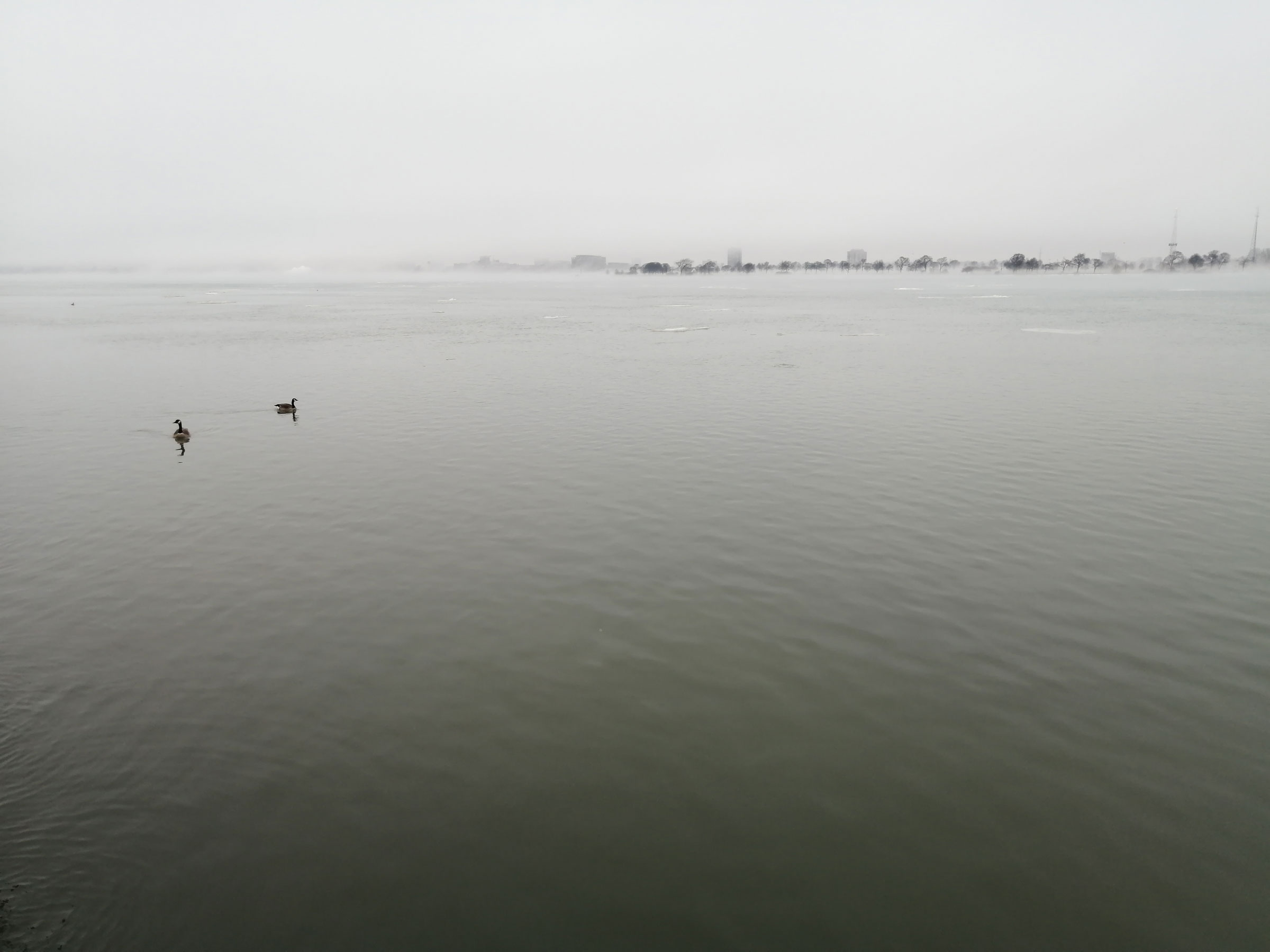
Standing at the concrete edge of a Chicago beach, you can almost rest your eyes from civilization.
As a teenage wannabe farmer feeling trapped in the city, I loved the lake for this reason. Behind me, the apartments and factories and train tracks weren’t just chaotic; they were a puzzle I couldn’t solve and a hand I couldn’t grasp.
I recognized this terrain of postindustrial memory immediately in the first story I read by Stuart Dybek, who’s written numerous collections about the city in the 1960s and 70s, cataloging and untangling a change I sensed, a lost world that stabbed at me.
His work consistently hits home, but none more than “Undertow,” which connects to my own family history while echoing my younger experiences of turning away from the roaring city humans had built to the organic strength of Lake Michigan.
In this chapter of the 2003 novel-in-stories I Sailed with Magellan, 13-year-old Perry rides through Chicago with his father, “Sir,” and younger brother, Mick, toward 12th Street Beach on a summer day.
Sir drives their rattling junk car past lumberyards, an electric plant, Chinatown shops, shabby streets, El stops, the telephone book printing factory where workers stare from the windows like inmates and the open-air bazaar on Maxwell Street where on Sundays he takes Perry to hunt for scrap wood and used plumbing fittings among frightening characters.
Then, sudden cold air and the beach, where the breeze “blew straight in over a horizon that was a blinding gleam, and beyond the horizon I could picture the forests of Michigan.”
The family has always come here to swim, but today their father plans to take them into deeper water, to the Rocks. Sir swam there as a boy, picking rocks up from the lakebed and carrying them back to the concrete beach with Johnny Weissmuller, an Olympic swimmer who went on to play Tarzan onscreen in the 1930s. The old-time swimsuit Sir still wears gives Perry a weak feeling, memories before their mother got cripplingly nervous.
“You shoulda seen this lake,” Sir tells his sons. “… when I was a kid you could see the bottom off the Rocks.”
Before I’d ever heard of Dybek, I heard similar stories from my father, who was raised in 1960s Chicago.
All four of his grandparents and their extended families left farms in the old country for this city. Some never adjusted; they planted backyard gardens their kids were ashamed of, couldn’t hold factory jobs, raised hunting dogs that paced the kennel fence unblinking when grandchildren came over.
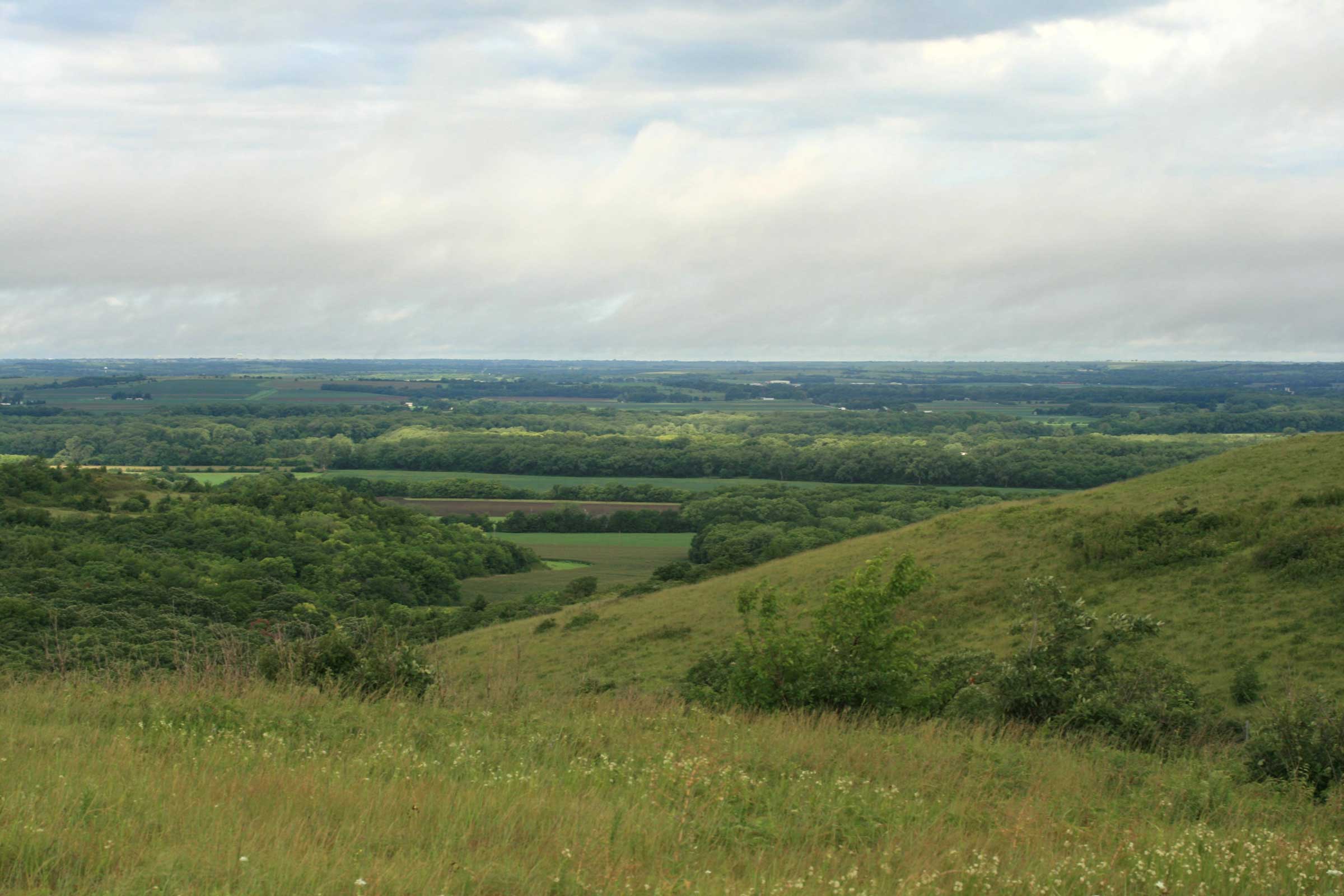
Wandering Chicago beaches and parks alone after school, I thought about them and tried not to remember that I was at least an hour’s drive away from any working fields. I was drawn to a life out there, with the physical world beyond people, but couldn’t figure out how to go, if it was still possible for me.
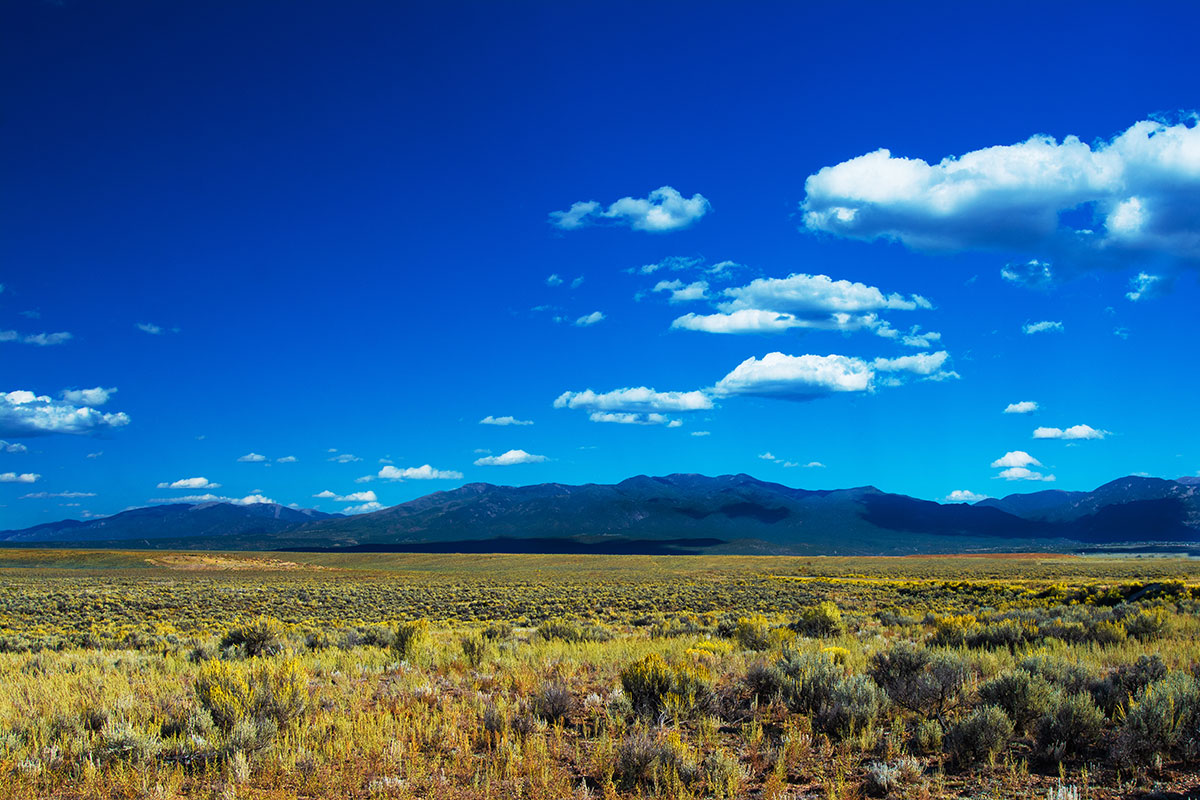
My father also wanted such a life, but he never got it. First, he needed the money, then he had the job, then people depended on it, then there was my mother, then there was me, then the three of us moving between other cities. We tried the country once, a mostly empty tract of desert where few people lived and little could grow. We left it to return to Chicago when I was 15.
I’d heard so much about the city, riding the train, running down the sidewalks, knowing the neighbors; I wanted all of it to still be real.
Sitting in someone’s mother’s SUV on a summer weekend, listening to friends argue over the white boy rap on the stereo, I could almost detach from the moment and step into another, of my father’s Chicago and the one known by two generations before him.
They swam with Weissmuller too, I’d heard.
In truth, their world was gone, the families and the factories and the people they knew. My dad said so himself with no audible disappointment. Driving through his streets and going to mixers after basketball games at his all-boys Catholic high school, I wanted to understand what had once been there and what it meant that it was lost.
At the same time, I missed living on open land as I knew they once missed it, though in the past I had hated the isolation – hearing insects, seeing animals other than the remarkable coyote. There was so much I had not learned, so much I feared it was too late to understand, about life in nature
Perry experiences something similar in “Undertow” watching his father search for scrap lumber: “His ability to gauge instantly the dimensions of things both mystified and intimidated me. It was a gift I seemed to lack completely, one expressed in a language I was ignorant of, with a vocabulary one needed to gain admittance into the practical world of men.”
His father has another language of secrecy — Polish — and, later in the story, speaks inaudibly to his son under the water at a life-and-death moment.
Perry is afraid at first to jump into the lake, where Sir is washing himself with laundry soap after a hair-raising “torpedo dive.” Mick is more interested in climbing a pile of limestone on land. Out beyond the Rocks blink lights that Sir says belong to an ocean liner.
A bystander warns Perry that the undertow is strong, says that someone went down and never came up earlier that day.
In the water, Perry loses his nerve once and then calls for his brother to watch as he dives, peeling through cold layers until he sees rocks, the ones his father saw when he swam with Tarzan.
No ancient history to be seen there; only seaweed and beer cans. Perry lifts a rock, but the current pushes him in, toward a cavern beneath the beach walkway where he fears he’ll disappear under the city forever.
He accepts he’s about to die, but Sir appears, pushing him up, appearing to say something his son can’t hear.
Could I understand my father? Could I know what people I never met had felt, in a city far from a home they’d never return to, when they looked out at the water and could catch a fish again, could feel a current or a fresh breeze?
Approaching shore, Perry realizes the beach is a solid wall. He shares a smoke with two Mexican boys on the concrete. He thought the big ship was coming in over him, he tells them. They laugh and say it’s only the pumping station. Even the real Tarzan wouldn’t swim out there.
In the dark, the lights appear to be slowly moving.
In time, my own memories — on top of other people’s — started to bind me to the places I passed walking toward city beaches: the sidewalk where I slipped on ice and skinned my knee after softball practice, the park we sat in to watch fireworks on the fourth of July. I listened to music on the public high school’s radio station and imagined something was knitting these sights into a larger whole, a dome of meaning containing my life or a current determined to carry me somewhere. Reaching the water, I would look out over it and think, like Perry, that I could see the forests of Michigan on the other side.
In a 2016 interview with The Rumpus, Dybek said each story in this book is built around a song. At first, I couldn’t locate one in “Undertow,” only a fragment Sir sings in the car, seemingly in passing. His singing embarrasses his sons, who laugh and cover their ears:
“Workin’ on the railroad, workin’ on the farm, all I got to show for it’s the muscle in my arm…”
“Looks like I’m never gonna cease my wanderin’,” he goes on.
E.N. Couturier is the author of Organic Matter (Autofocus Books, 2025). Her work has appeared or is forthcoming in jmww, Farewell Transmission, Offrange and elsewhere, and has been nominated for Best of the Net and the Pushcart Prize.
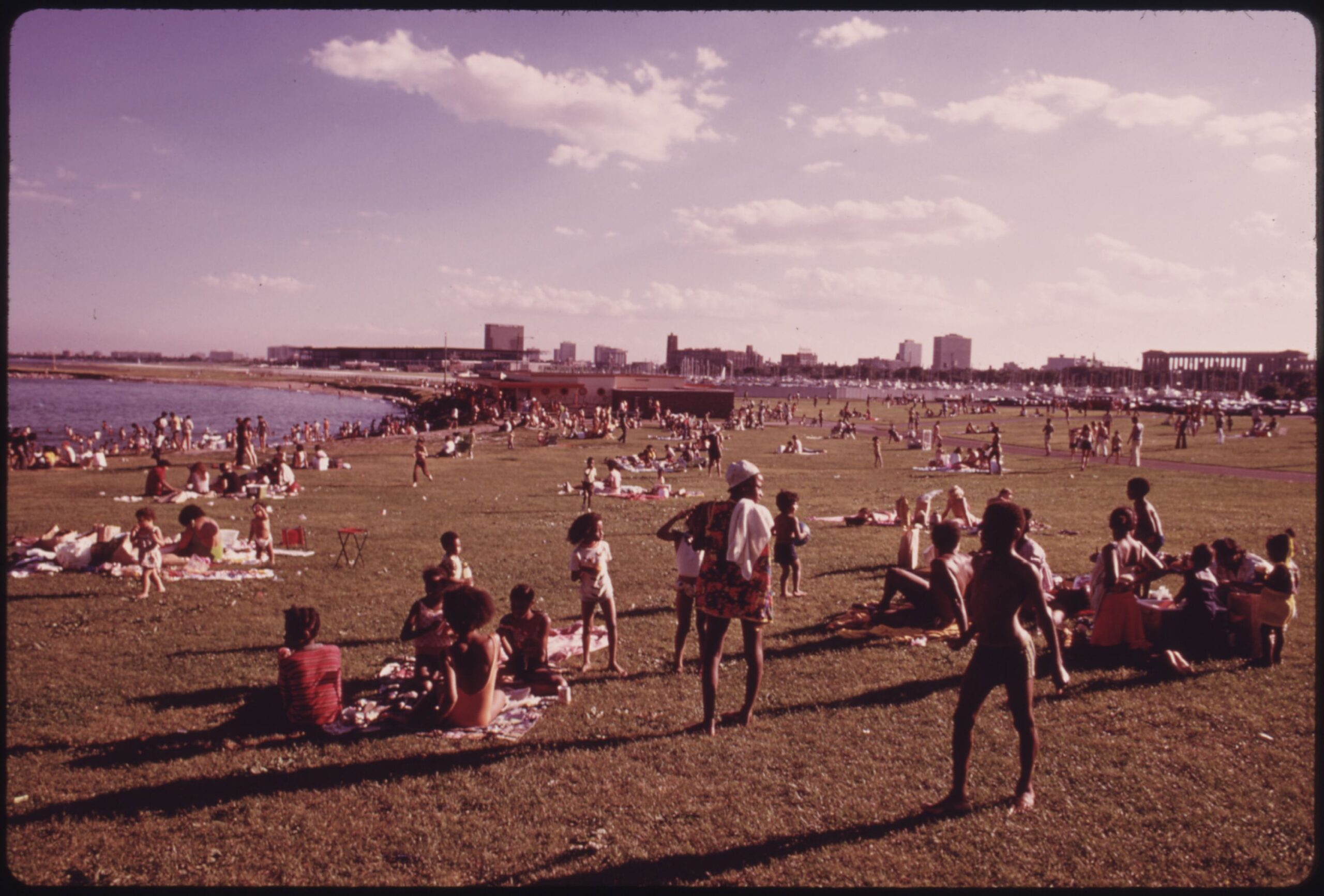
Photo by John H. White, 1973. Courtesy of the National Archives and Records Administration, NWDNS-412-DA-13844.

![Mark Twain in Study Window [1903]](http://newterritorymag.com/wp-content/uploads/2025/12/Twain-in-study-window-1903.jpg "Twain in study window 1903")