
Mark Twain
Dollis Hill House
London, England
By Thomas Ruys Smith
It’s the first real day of spring and I’m in Dollis Hill — an unremarkable suburb of North London that sits just inside the North Circular, the multi-lane road system that encircles the centre of the capital and is synonymous with traffic congestion and an entrenched atmosphere of urban decay. Still, in Gladstone Park, the sun is out and so are the local residents: in the ruins of what was once Dollis Hill House, a children’s birthday party is winding down just as a group of women begin an impromptu karaoke session; our miniature schnauzer Winifred is making the acquaintance of a fluffy white pomeranian apparently named Snowflake. This might seem an unlikely location for a ghost-hunt, but that’s why we’re here.
If you wanted to seek for the restless spirit of Mark Twain, there would be worse places to begin, at least according to the man himself. Interviewed in 1907 as he embarked on what he knew would be his final trip across the Atlantic, Twain was clear that he intended to spend his afterlife in the modern Babylon that had often served him as a second home: “I may never go to London again until I come back to this sphere after I am dead,” he told a reporter, “and then I would like to live in London.”
As an academic based in the UK, I’ve spent much of my career exploring Mark Twain’s relationship with the Mississippi River, tracing the way that the river wound its way through his life and work. In surprising ways, that muddy water often washed up at my own front door across the Atlantic: British writers had a surprising influence on the creation of the Mississippi as a powerful global emblem of America. Now, though, I’m reversing that transatlantic equation. It seemed time to pursue the traces of Mark Twain in my own backyard — in London, the city in which he spent roughly three crucial years on numerous trips, from his inaugural visit in 1872 to his final victory lap in 1907. A number of Twain’s London residences still exist, most famously the Langham Hotel which hosted his early visits and the house he rented at 23 Tedworth Square in affluent Chelsea, which bears a blue plaque erected by English Heritage to announce to passers-by that Mark Twain, American writer, had once lived there in 1896-7.
For me, though, there is something especially evocative about Dollis Hill House, occupied by Twain with his wife Olivia and daughter Jean in the summer of 1900. Compared to the glamour of his first trips to London as a literary lion ensconced in the Langham, or the awful gloom of his secluded residence in Tedworth Square after the death of his daughter Susy, there is an appealing softness to Twain’s time in Dollis Hill: after years of personal turmoil, including bankruptcy, the months he spent in the house were a relatively sunny sojourn. By 1900, his fortunes had been largely restored, enough for his family to return to America after a period of financial exile in Europe, and Dollis Hill House was a final hiatus before the end of this odyssey.
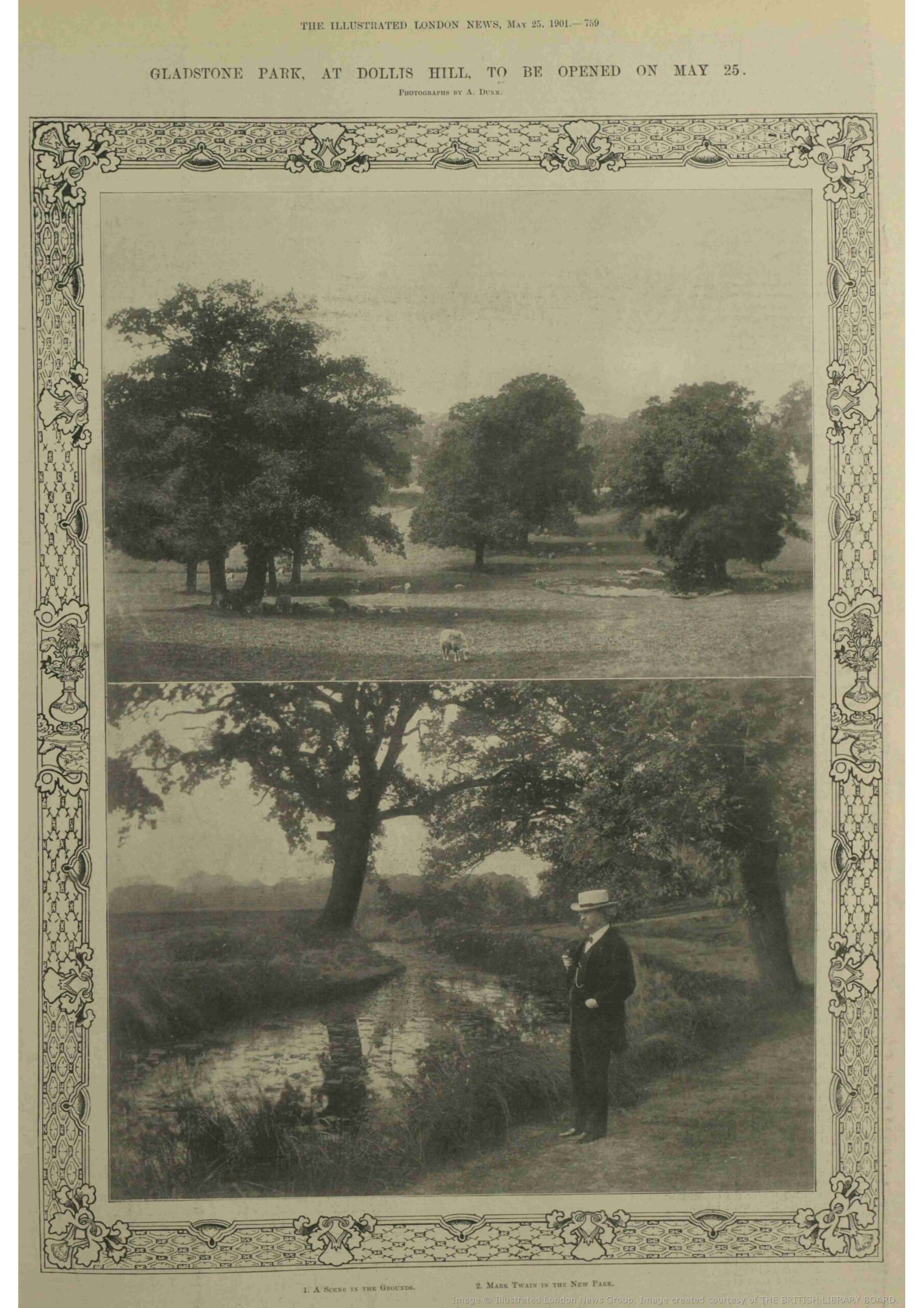
Twain’s description of this time exudes a warmth and peace that was rare in his later years: “Dollis Hill House comes nearer to being a paradise than any other home I have ever occupied. … It is within a biscuit-toss of solid London; yet it stands solitary on its airy hill, in the centre of six acres of lawn, and garden, and shrubbery, and heavy-foliaged ancient trees.” His only complaint was the lack of a telephone. Today, of course, London has swallowed up Dollis Hill and what had been “country, pure and simple” to Twain is now surrounded by urban sprawl. Even on a warm spring day, “paradise” seems a stretch. However, as Twain himself noted, the land around the house had just been “bought for a park, to be for all time a memorial to Mr. Gladstone” — a frequent visitor to the house during his time as Prime Minister — which meant that, to some extent, the landscape that Twain loved really would “remain as it is.” Unlike hotels or his other residences that still function as private homes, this Twain-imprinted place remains immediately and freely accessible to all.
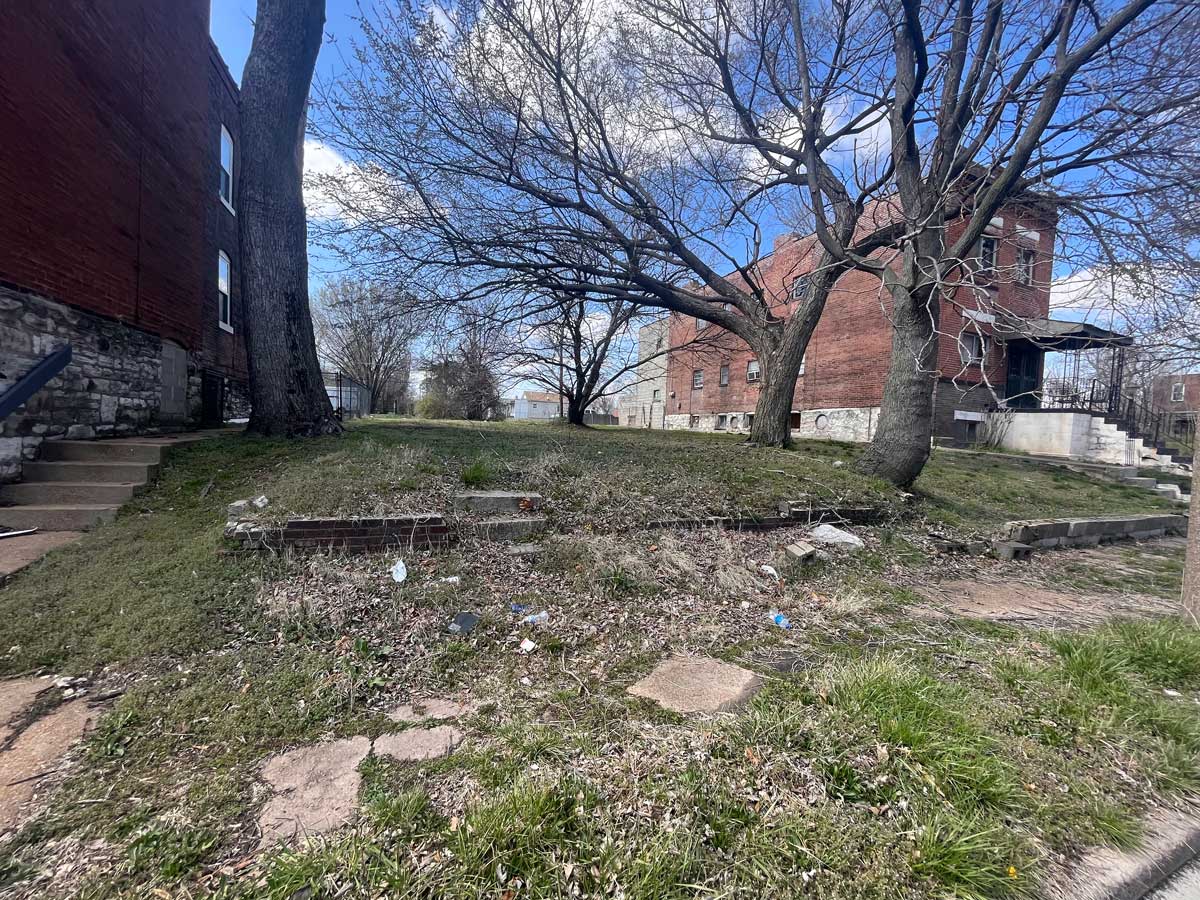
There’s also something about Dollis Hill House’s ruin that adds a poignancy, and a piquancy, to its association with Twain. A series of fires in the late 1990s left it a derelict shell. Though money was earmarked for its restoration, it became a casualty of austerity when former Prime Minister Boris Johnson canceled the funding during his time as London Mayor. A final fire in 2011 precipitated its demolition. Now, it remains an absent presence in Gladstone Park: a short course of bricks marks out the building’s floorplan and a fragment of one wall remains. People make their own use of this liminal space — like today’s birthday party.
An absent presence is also how I’ve come to think about Mark Twain as I search for him in London. Today, I can’t swear that the park-goers in Dollis Hill are thinking much about its famous former resident, but across the closing decades of the nineteenth century London was infatuated with the writer who seemed to embody their dreams, and sometimes nightmares, about America. In 1907, local newspaper The Hendon and Finchley Times proudly claimed him, “Our friend Mark Twain, who is associated with this district owing to his residence at Dollis Hill House.” Another paper judged that Twain’s connection to Gladstone Park would “add a certain … literary flavour in the public mind to its natural attractions.” These are vivid and hyperlocal examples of what Twain’s some-time associate Ralph Ashcroft declared in 1907: the English — and Londoners in particular — were “part-owners with the American nation of Mark Twain.”
In turn, Twain himself was infatuated with an urban space that was like no other on the face of the planet. “Everything in this monster city interests me,” Twain announced during his first time in London. And it always did. I would argue that outside of America, there is no other location that meant as much to him, or that had as much influence on his sense of self. Just as this ruined corner of London will always be a little paradise for Twain’s ghost, so London should always be a part of our understanding of this iconically American writer. And for me, there is something particularly significant about having this enigmatic shell on my doorstep, a short drive away from my own home along the grey river of the North Circular. Tracing the outlines of the rooms of Dollis Hill House as my daughters eat an ice cream purchased from the old stable block and modern life buzzes throughout this liminal shell, I can conjure up Twain as a near-neighbour, a fellow suburbanite, a Londoner, available for afternoon calls. In Gladstone Park, the sun is shining, and Mark Twain is lounging in a deckchair beneath the trees, forever.
Thomas Ruys Smith is an academic and writer who specializes in the study of nineteenth-century America. He is Professor of American Literature and Culture at the University of East Anglia in the United Kingdom and co-editor of the journals Comparative American Studies and New Area Studies.
“Gladstone Park, at Dollis Hill, to Be Opened on May 25.” The Illustrated London News, 1901.

![Mark Twain in Study Window [1903]](https://newterritorymag.com/wp-content/uploads/2025/12/Twain-in-study-window-1903.jpg "Twain in study window 1903")