
James Whitcomb Riley
528 Lockerbie St.
Indianapolis, Indiana
By Ray E. Boomhower
As a young journalist working for the Anderson Herald in the early 1980s, I often wondered, as I typed away at my stories about school board meetings and small controversies about drainage issues in Pendleton, Indiana, if anyone who worked for one of the city’s newspapers had gone on to win literary fame. I was surprised to find out that the beloved Hoosier Poet himself, James Whitcomb Riley, had been an assistant editor at the now-defunct Anderson Democrat.
Unfortunately, Riley’s tenure at the Democrat ended in disaster. A scheme he concocted with a fellow editor in Kokomo to bamboozle Eastern publishers with the discovery of a theretofore undiscovered Edgar Allan Poe poem (titled “Leonainie”) collapsed, and Riley lost his job. “It was the most dismal period of my life,” Riley admitted years later. “My tinsel throne was crumbling. Friends stood aside — went around the other way.”
Riley persevered. He found work on the Indianapolis Journal and began winning acclaim for his poetry. One of his poems inadvertently led to a lasting connection with a city neighborhood. Driving with a friend one afternoon in 1880, Riley, a former traveling sign painter, came upon a shady spot at the corner of Lockerbie and East Streets. He observed a young woman drive past in a small, clay-colored carriage, stop, and enter a stately brick home.
Entranced by what he had seen Riley returned to the neighborhood a few days later. “Walking back to the office, I repeated the phrase with every footstep — Lockerbie Street — Lockerbie Street. The words clung to me like tickseed to a tiger,” he said.
From that experience Riley wrote the poem “Lockerbie Street,” published in the Journal. The work praised the thoroughfare for offering shelter from the usual noise of the big city:
There is such a relief, from the clangor and din
Of the heart of the town, to go loitering in
Through the dim, narrow walks, with the shelter shade
Of the trees waving over the long promenade
And littering lightly the ways of our feet
With the gold of the sunshine of Lockerbie street.
The day the poem appeared Riley found that his office had been stuffed full of flowers from grateful Lockerbie residents.
Riley had numerous opportunities to experience the pleasures of residing in such quiet and contemplative surroundings. From the summer of 1893 until his death in 1916, he lived quietly not as a homeowner, but as a paying guest in Major Charles L. Holstein’s house at 528 Lockerbie Street. The two-story, Italianate-style structure made of brick had been built in 1872 by Indianapolis baker John Nickum, Holstein’s father-in-law and a Riley confidant. Today the home, which is listed on the National Register of Historic Places, is open for tours on a regular basis.
Riley had been born in a log cabin on October 7, 1849, in Greenfield, Indiana, the second son and third of six children born to Elizabeth Marine and Reuben Riley, a Civil War captain, lawyer, and Indiana legislator, and. At an early age the future poet discovered that he disliked the “iron discipline” of school life, but enjoyed books, music, and writing poetry. “My father did not encourage my verse making for he thought it too visionary, and being a visionary himself, he believed he understood the dangers of following the promptings of the poetic temperament,” Riley said. “I doubted if anything would come of the verse writing myself.”
Possessing a wanderlust spirit, the young Riley spurned law for another pursuit—art. He traveled the countryside with a group of friends he dubbed “the Graphics” as sign, house, and ornamental painters. Riley later became an advance agent for a traveling wagon show. In 1873 he returned to Greenfield and worked for the town’s newspaper. A year earlier, his poetry, under the name “Jay Whit,” had first appeared in the Indianapolis Saturday Mirror.
After his short stint at the Anderson Democrat, which ended prematurely because of the Poe hoax, Riley found work the staff of the Indianapolis Journal.
While at the Journal, Riley achieved acclaim for his poems, especially “When the Frost Is on the Punkin,” part of a series he signed Benj. F. Johnson, of Boone. The series was published in book form in 1883 as The Ole Swimmin’ Hole, and ’Leven More Poems, under his own name. Riley’s characters — Old Aunt Mary, Little Orphant Annie, The Raggedy Man, Doc Sifers, and Uncle Sidney — along with his sentimental style, struck a chord with the reading public, who flocked to hear him recite his work on the lecture circuit.
Riley’s lectures helped make him a household name throughout the country, but his hectic schedule soon took its toll on the poet, who, when he returned to Indianapolis, lived for a time at the Denison Hotel, one of the city’s finest. “I am getting tired of this way of living—clean, dead tired, and fagged out and sick of the whole Bohemian business,” lamented Riley.
There are several stories about how the poet, a lifetime bachelor, abandoned his footloose existence for the comfort of the Holstein home. According to Riley biographer Marcus Dickey, the author boldly announced after dinner one night with the Holsteins, “I am never coming back again except on one condition.” When a perplexed Holstein asked what that condition might be, Riley replied: “That I come as a boarder.” Another version, this one from Riley’s niece, involved a mix-up during a vacation at French Lick. By mischance, all of Riley’s luggage was sent to the Holstein mansion in Indianapolis, and the poet decided he might as well make his home there.
However Riley happened to decide to live as a paying guest with the Holsteins, he settled comfortably into his new surroundings. Katie Kindell, who served as housekeeper during Riley’s residence there, noted that the poet often wrote in bed as much as at a desk, always keeping paper and pencil close by in case an idea for a poem might come to mind. His advice to young writers, said Kindell, was to “use the rubber end of your pencil as much as the point. Write and rewrite.”
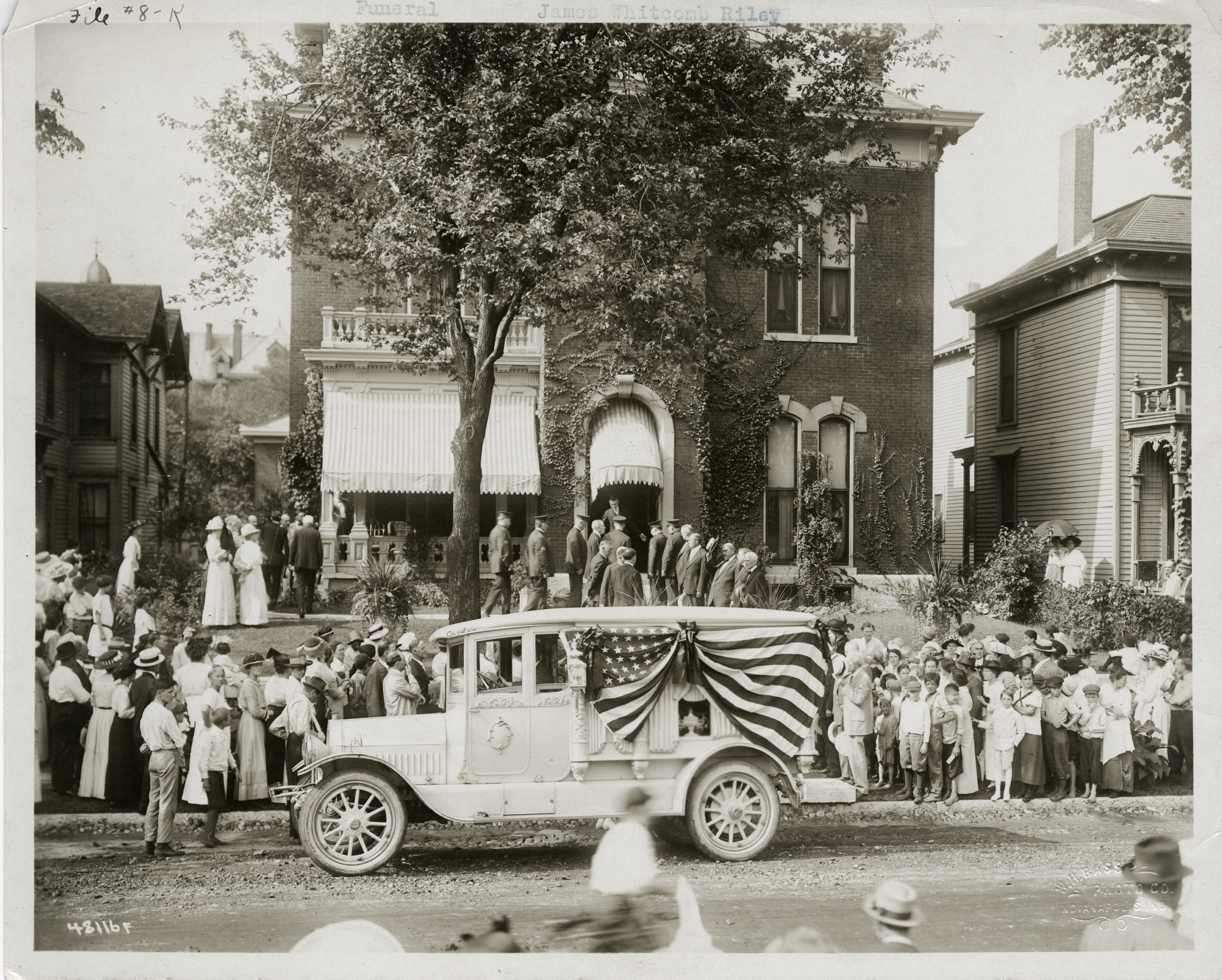
The Holstein home became a regular visiting place for Indiana schoolchildren and for famous figures like perennial Socialist presidential candidate and labor organizer Eugene Debs, who enjoyed raising a glass (or more) of spirits with Riley whenever possible. Riley’s fame grew so great that his birthday was celebrated by students throughout the country. After his death, which came as he slept in his room in the Holstein residence on the evening of July 22, 1916, a crowd gathered outside of the home to watch as pallbearers carried his casket to a flag-draped hearse (see photo). More than 35,000 people filed past Riley’s casket as it lay in state under the dome at the Indiana Statehouse — quite a turnout for a once-disgraced newspaperman.
Ray E. Boomhower is senior editor at the Indiana Historical Society Press, where he edits the quarterly popular history magazine Traces of Indiana and Midwestern History. He is the author of twenty books, the most recent being Wallace Terry: A Reporter’s Journey from Selma to Saigon to Bloods and The Ultimate Protest: Malcolm W. Browne, Thich Quang Duc, and the News Photograph That Stunned the World.
Photo courtesy of the Bass Photo Collection, Indiana Historical Society.

![Mark Twain in Study Window [1903]](https://newterritorymag.com/wp-content/uploads/2025/12/Twain-in-study-window-1903.jpg "Twain in study window 1903")