
Ross Gay
Sample Gates
Bloomington, Indiana
By Ryan Kegley
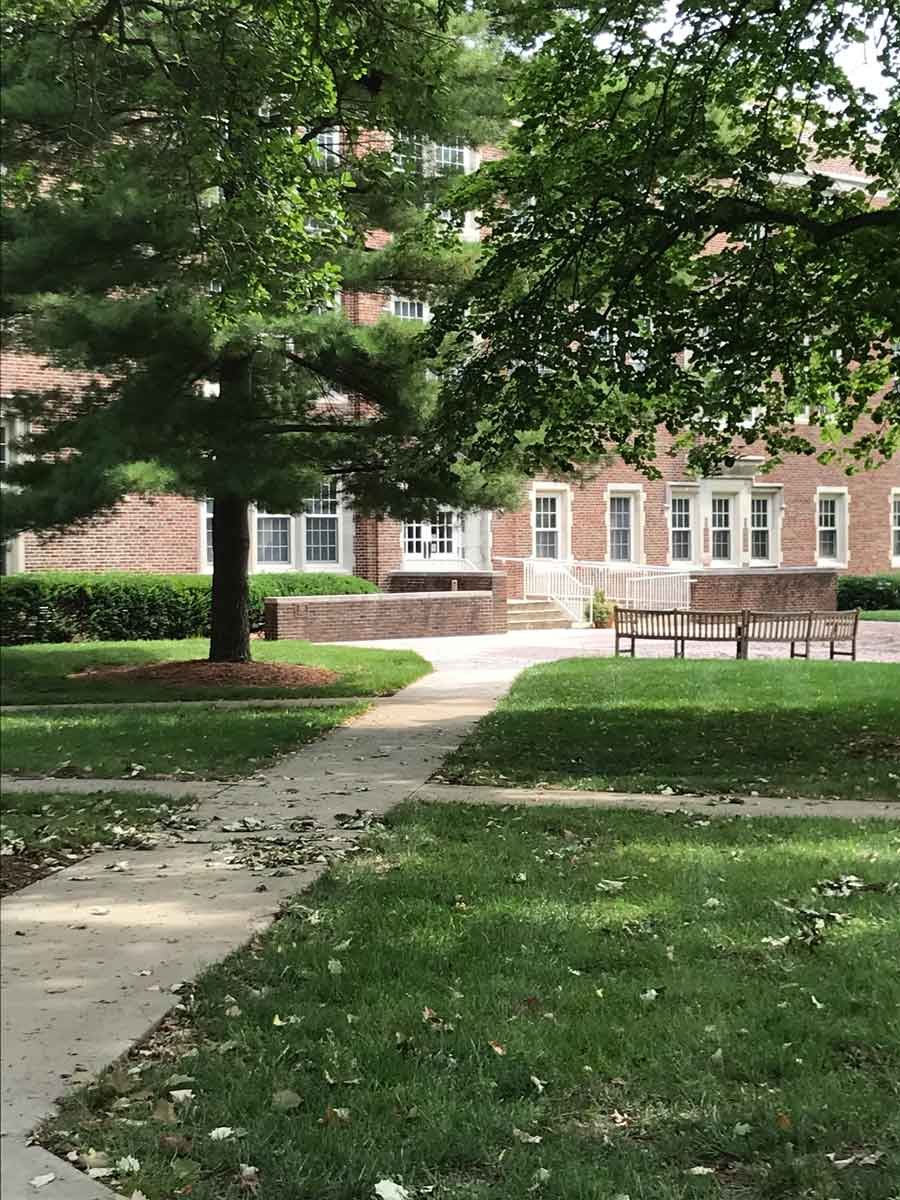
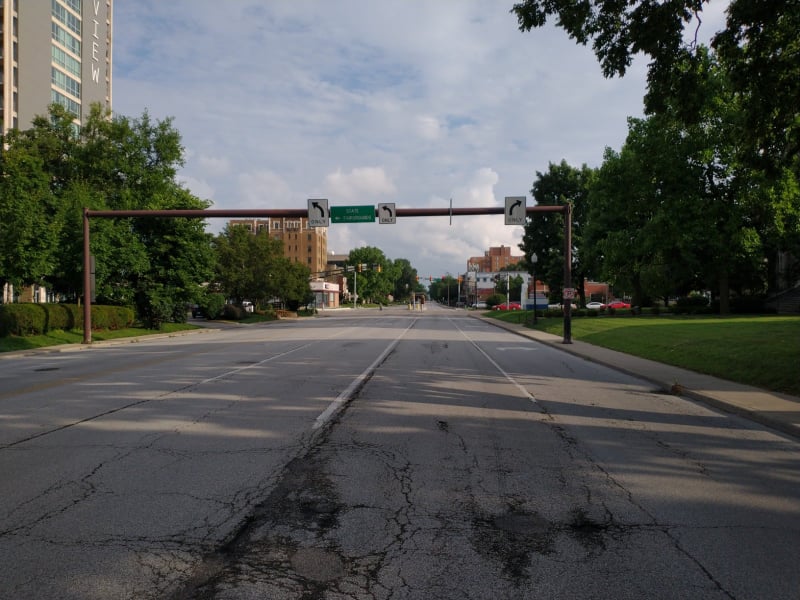
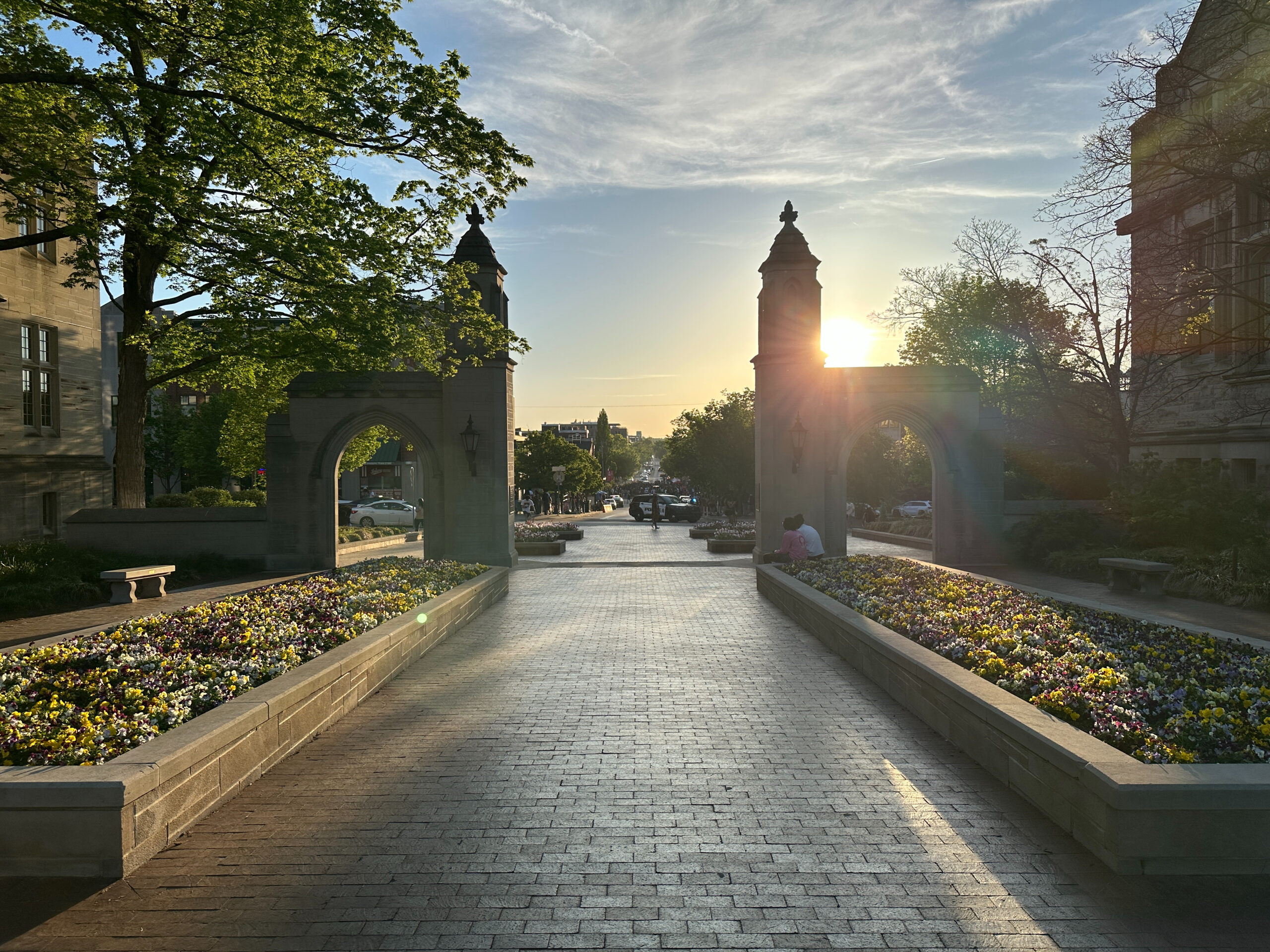
It is just past dawn, and I am standing in the middle of the Bloomington Community Orchard, the one-acre edible public park that poet, professor, gardener, and self-proclaimed joyologist Ross Gay co-founded. It is just before noon, and I am drinking on the crowded patio of Upland Brewing, where most of us are getting loosened up for, and speculating about the likely winners of, the 75th Anniversary running of the Little 500, the single-gear men’s and women’s bicycle races modeled after — what else? — the Indianapolis 500, known as the Greatest Spectacle in Racing. It is late afternoon, and, at lap 63, I am evacuating Bill Armstrong Stadium alongside tens of thousands of others, the jolting danger of nearby lightning making way for whipping winds and a brief but soaking downpour before passing through and, mercifully, allowing the race to resume. It is early evening, and I am loitering at the Sample Gates, the entrance to campus and front seat to a dichotomy of almost-graduates posing in academic regalia and throngs of revelers spilling into and out of downtown bars. It is after midnight, and I am lolling under a lamp near Ballantine Hall, the ten-story classroom monstrosity built in 1959 in the heart of campus, once the world’s largest academic building, where, as a junior, I took my first poetry-writing class.
In all of these moments, both literally and figuratively, I am revisiting the place where I first encountered Ross Gay: his 2015 collection, Catalog of Unabashed Gratitude.
If home and high school meant conflict and constraint — immovable object met by unstoppable force—then college and Bloomington meant promise and possibility — hope sprung eternal. Thirty years later, in the fullness of spring and the convergence of these myriad beginnings, I pull out my copy, take a drink from its cup, and offer it aloud to the trees and the birds, to the morning air and the afternoon air, the night air and the in-between air, to the skies that hold us in, to the daytime sun and the nighttime moon, and, occasionally, to the stranger who happens up my performance, for it is a performance: slightly stupid, possibly courageous, truly earnest, and wildly, unforgivably, nostalgic.
Surrounded by twenty-somethings cheering and chanting and bursting with potential, with youth, caught between yesterday and tomorrow, ushering in adulthood’s delivery, I was simultaneously carried forward and transported back — past, present, and future merged into a single tense. We thought we’d savored those days, but savoring, like youth, is lost on the young. We had no idea. I returned, this time as the others, not to relish past glories, but to wash myself anew in a fountain that never ages, to recognize we weren’t yet ready to be grateful for anything, to learn to weave these threads into a tapestry.
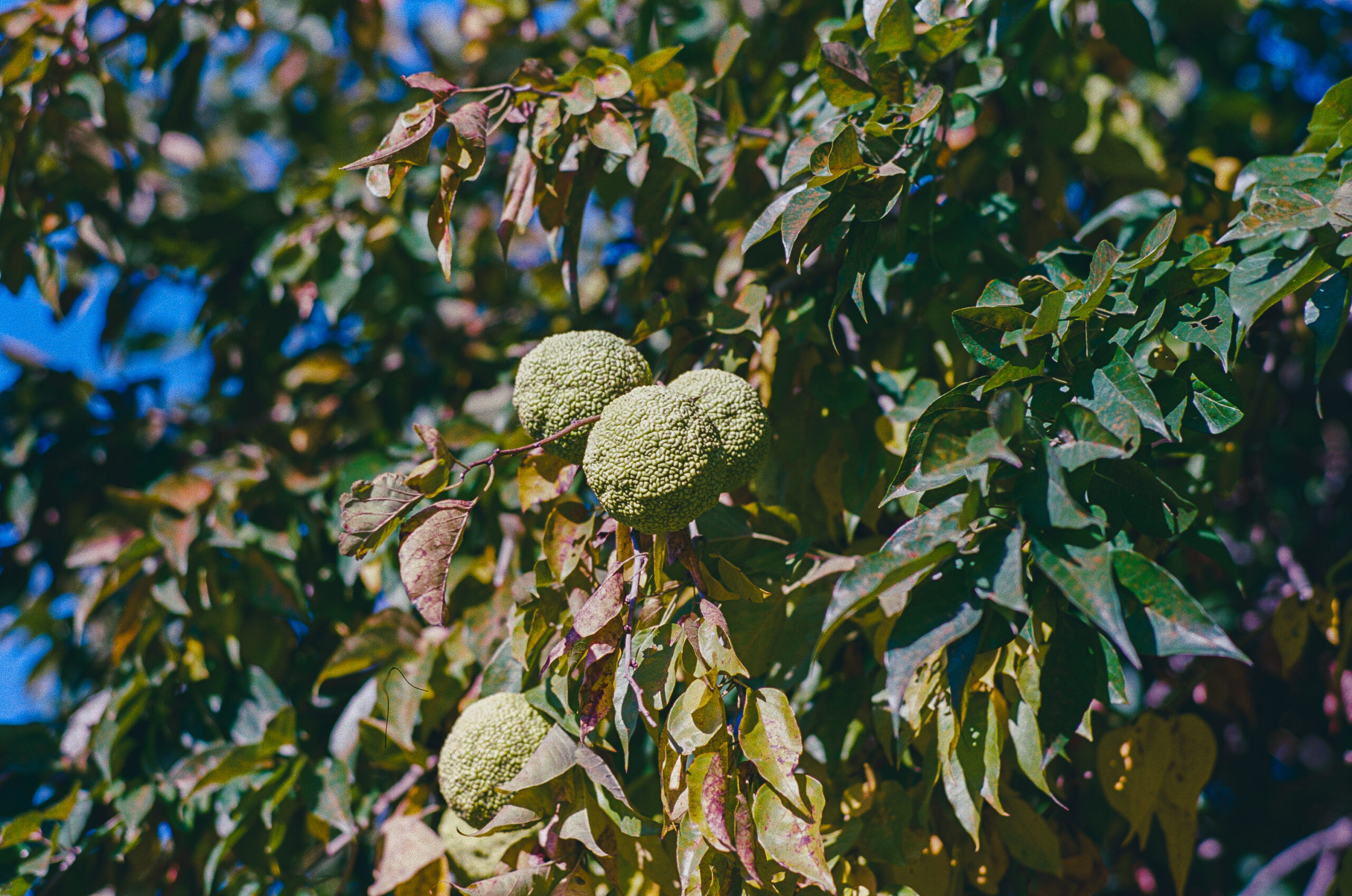
Which is maybe why, I realize at long last, I keep returning to Bloomington, and to Ross Gay’s Catalog: That youth, like the simple pleasure of buttoning and unbuttoning one’s shirt, like the lusty pungence of pear blooms, like the way the mistake in a poem is a gift, like biting into a fig to find it impregnated with ants, like the way it is difficult to both jump high and snatch gently the delicate fruit of a mulberry tree, like the way a catalog of gratitudes can make me weep with pain and joy in equal measure, is messy and perfect and perfectly messy, is pushing a seed into the ground to see what multitudes might be harvested, is fruit ripe for the plucking, is that first, delicious bite, juices dripping down our chins in easy ecstasy.
Just past dawn, leaves glistening in the fresh daylight and feet wet with dew, I am standing, once again, in the Bloomington Community Orchard, where untold hours of watering and weeding and tending, in common, in communion, in countenance to and for and with each other, Gay’s poetry, deceptively layered and nuanced and, as often as not, unadorned by punctuation or capitalization, has found cause for celebration, as we have found cause to celebrate it. His is a welcome invitation to slow, to settle, to linger, to breathe, with intention and meaning, into the fullness, the complexity, and, yes, counterintuitively, the simplicity of life. As I drive north, airport-bound, everything is bursting, is flowering with promise. Like an orchard, like the Little 500, like a poem rooted in place, like the rituals of youth, like a visit to my alma mater and the Sample Gates and the town that surrounds it, we, like Gay, put our hands to the soil, mind and attend, wish and wonder and work, and reap untold bounties.
Ryan Kegley’s work has appeared in Writing the Land: Wanderings I, The New Territory, the Wellington Daily News, and elsewhere, and has been nominated for the Pushcart Prize. His first full-length poetry collection, In the Bewilderment, was released in August 2026 by NatureCulture. He lives in the Flint Hills on the outskirts of Manhattan, Kansas. You can find him at ryankegley.com.

![Mark Twain in Study Window [1903]](https://newterritorymag.com/wp-content/uploads/2025/12/Twain-in-study-window-1903.jpg "Twain in study window 1903")